Category Archives: Job search and CV help and advice

Getting good at something

This applies to many things, however, the core of this premise is its applicability to your work, no matter what it is.

Be so good that your colleagues, clients and bosses have to take notice of the work you do.

It might be the way you do it. The level of quality that you are reaching every time you send an email, for example. The style of your communications. The way you listen.

Or it could be a technical proficiency. Something you’ve honed over many years of practice and repetition.

Whatever it is, work as hard as you can on making it a little better every day.

It is not wasted time. The effort will stand up under pressure.

Sometimes this stuff is drowned out by the policiticans that inhabit every workplace. The game-players. The ones who will burn anyone to get what they feel they deserve.

In general – and I have seen this play out over time – those with the skills become dependable, reliable, and essential to leaders when they’re making their picks.

I know which camp I’d rather be in.

Adult behaviour

What do I like when I deal with other people?

  • On time.
  • Honesty.
  • No drama or histrionics.
  • Professional all the way.
  • No swearing.
  • They listen to everything I say.
  • No interruptions.
  • No talking over me when I speak.
  • Clean and presentable.
  • Positive and confident body language.

How do I get this from other people? Do ALL OF THE ABOVE for them first.

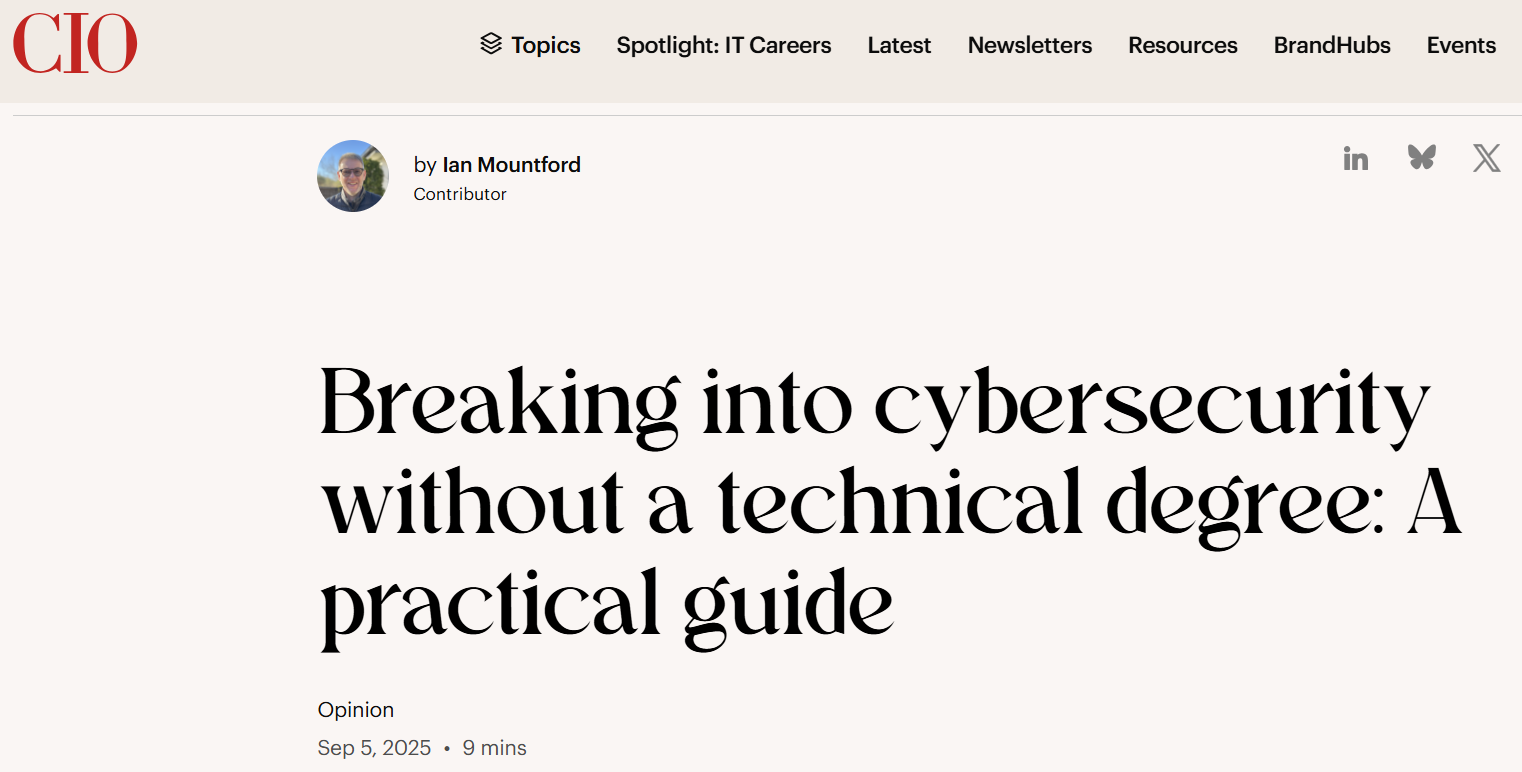
CIO.com article on cybersecurity careers for non-technical people

https://www.cio.com/article/4051515/breaking-into-cybersecurity-without-a-technical-degree-a-practical-guide.html

I was kindly offered the chance to write this article and it’s been published this week.

It gives a solid summary of my own experiences, good and bad.

If you’re in the market for a new career and cyber has caught your eye, read on.

And if you’re not a coder, even better.

Computerworld interview – my career journey

My career journey has been an interesting one.

My mate Matt has got the best out of me here and dug a bit deeper than the usual stuff these videos contain.

Lots of good stuff in here if you’re on the path to a cyber career, or really any kind of new career and find yourself in transition.

On expertise

Pick your one thing as early as you can and become an expert at it.

There’s an example I heard of a top tax lawyer being very happy with the way their life has worked out after a couple of decades or more working in a narrow, perceivably dull, area.

Go deep and narrow. There will always be good things going on there the longer you stay in the space, learning and evolving.

The tax lawyer will be satisfied at the end of their working days once they retire, financially secure, with a legacy earned from a raft of loyal clients.

They may have built their own practice or just be a well-known expert in the space in high demand.

Assume you can do this for yourself and work hard to achieve it in your space.

How ‘good’ is your network?

When talking about networks and networking, it can be understood as a very general term. Our family networks, small or large, are as valid in a discussion as our wider business connections. 

‘Good’ is too broad a term to use, so I’m going to replace it with ‘effective’ – successful in producing a desired or intended result (from the dictionary).

A couple of ways of determining the answer here is to look at its strength and value:

  • Does it help you to answer important questions in your life and work? 
  • Is it a group of guys or gals you meet at the bar or coffee shop and hang out with weekly? 
  • Does being a part of it make you a better person? 
  • Is it somewhere you have fun and meet new people?
  • Does it make you money?

I think an effective network has to have a mixture of these things going on within it. 

Not all networks make money and some of them would never fall into this category directly, but there could be cases where a network can bring up a conversation that leads to a meeting or sale further on down the road.

The informal meetups with your friends can also be strong and supportive networks. Sometimes a chat with a trusted friend makes all the difference if you have a difficult decision to make.

It all takes an investment of time and effort (all the good stuff needs both these things). Even if it’s only making a couple of calls and being the organiser to get a few folks together every now and again, it’s worthwhile.

I’m a member of a couple of formal networks where we pay membership fees and attend regular events. These networks are great because everyone involved is well and truly committed to being a part of it and puts in effort to make sure they get value for the fees they are paying.

But being part of a sports team or a club, a yoga studio community, a book club or a music group can have the same effect. 

The bottom line, for me, is that you get out of it what you put into it. And the same applies to online communities, too… but I’ll save this discussion for another day.

What are you measuring?

I never used to measure anything and loved living in the land of always being ‘nearly there’. 

No matter what I was working towards, I was never that far away from completing it and the end was always in sight.

Until it wasn’t and the target was missed.

On a diet? Yeah, those pounds are coming off. How much have you lost this week? Oh, I think I had salads on Tuesday and Wednesday so I’m definitely going to be lighter…

Training for that marathon? It’s going brilliantly. How many miles have you done this month? Ahh, I reckon I could have run three this week already…

And when it came to business, I would always let my bank balance and the accountant give me the good or bad news. The day of that meeting was always high anxiety.

And then I started measuring. I really went for it. 

I track as much as possibly can to make sure I’m heading towards my goals and it’s made a massive difference. 

I can see clearly when I’m on track and improving. I can see the areas where I’m falling behind. And, most importantly, I can see the pieces of the puzzle that are missing as I work towards a specific target every day. 

One of my metrics is all about meetings with contacts and connections. I would happily sit at my desk all day and meet as few people as possible but I know this is no way to grow a business and build a network. So I track the numbers of meetings I have through each week.

And the fun starts when I watch how much new business I close as the number of meetings I take each week increases. 

It’s a clear and simple feedback loop that tells me that I’m heading in the right direction.

Measuring makes it clear what works and what doesn’t. I know what needs to change. I know what I can improve on.

In the areas that matter the most to you, this process can be invaluable. If you’re looking for work, for example, knowing that you have hit your target of five new applications every day will give you confidence that it’s only a matter of time until the phone starts ringing with offers.

Measure and track progress. Obsess on it.

It’s a step on the path to success, no matter what goals you have. 

Preparation and why it matters

child-head-in-hand

I had to take some tests yesterday. Nothing to be concerned about (until I find out how I did, of course) and related to employment but the process I undertook highlighted how easy it is to become very anxious if you are not prepared.

The tests were psychometrics on verbal, numerical and logical reasoning and not something that I have ever had to do before in a formal setting, i.e. going for a job. I have administered tests in the past and provided practice tests to students whilst working at a university a long time back, but doing them for myself was tough.

Thankfully there was an option for practice and also a lot of information on how to approach and take these tests online, so I spent as much time as I had – not a great deal – attempting a few of these practice tests and getting to grips with the question types, the ‘race against time’ that these tests are, plus trying to ensure I was as prepared as possible.

The testing process is very important in hiring decisions and has been used with great success for many years, predominantly as a support to the deeper process of interviewing and assessing competencies of candidates. If I had been presented with these tests yesterday, say, just following an interview and with no time to practice, I would have been in real trouble and it rammed home to me how important it is to be as prepared as you can be for the things that we get thrown at us in our lives.

I did not think at this stage in my career that I would be asked to do a raft of psychometric tests but the fact that I did has shown how crucial it is to never get complacent or think that you have all the bases covered. Be prepared for ANYTHING that can come at you. Take some time to step back and look at the bigger picture. Think about what’s on the table in any particular instance. What am I going to need to do in order to get over the line and make a success of this?

Focus on the good stuff

The process of making change is one that can add levels of frustration, anxiety and straight-up fear to lives that are already highly stressed and this isn’t always a good thing. Illness can follow very quickly behind if the change isn’t properly managed, whatever it’s context, so avoiding this has to be a top priority.

Our move to Sydney is still in progress as the container carrying our belongings is not yet with us and, so far, we have thankfully had few problems. But Katherine did get sick after only a couple of days in the country and this was very likely due to the scale of the change we had undertaken and the unsettled nature of what was ahead of us over the next few weeks of looking for accommodation, settling into a job and a new city, etc.

The frustration around the change I am going through at the moment is about the pace of it. Life in Australia does go a whole lot slower than it does in the UK and this can be difficult when you have little patience and are ready to start something new. A phone call or email not being returned seems to increase the overall level of tension and the ability to stay patient pays huge dividends.

I try to solve these little problems by thinking of all the things that have worked out well over the last few weeks as we have moved our lives and there are lots of them. It’s always beneficial, to me, anyhow, to keep a focus on the good stuff and the positives that are around me instead of the negatives and this does seem to do the trick. The negatives come easy and are always there without looking too hard, but make an effort to see past them and the dark clouds will start to lift a little.

Your CV – check, check and check again

My latest post from LinkedIn:

sherlock holmes

Many CVs are full of errors and this is something that is easy to fix. Check your document, get others to proofread it, then recheck it to make sure there are no mistakes. If it’s a straight choice between two applications for a role and one of the CVs has no spelling errors, who do you think gets the invitation to interview? It can really be that simple.

Make sure your address details, telephone number (mobile only) and email address are clear and correct at the top of each page. If you’re in the process of relocating to a new area, it can also help to add to any covering letter or email what your plans are, otherwise it can cause real confusion and lead your application to the trash.

Check all of your spelling, grammar, punctuation and layout on the document. Think of the reader and what they are going to think of the way your document has been prepared – it really does make a difference when you are looking at lots of these every day.

And be sure to check your facts, statistics and data. Don’t be caught out by an employer doing their standard due diligence on you as a candidate and identifying a glaring exaggeration of sales figures or project details. If they decide to interview you, which would be unlikely if you make this kind of mistake, they are sure to ask you to justify your version of the facts so avoid this potential banana skin.

[If you need any help with your resume/CV, please check out my other site https://realjobsearchinsider.wordpress.com/]

Checklist – things to ask and consider when you’re looking for a new job

Here’s a list of things that are worth finding out and thinking about as you go through the decision making process of deciding to take a new job or stay where you are. Got any additional ones? Please add them in the comments.

  1. What’s the travel time and is it a decent commute.
  2. Are there good facilities for staff in the office, eg kitchens, rest areas, car parking.
  3. Is the salary competitive with similar roles at other local/national companies.
  4. Is there a good benefits package – health care cover, pension provision, day off for your birthday, free snacks, etc.
  5. Is there a solid training and development programme in place or a culture of learning in the company.
  6. Do you get to work on any special projects outside of your role, or can you volunteer for additional work on projects that interest you.
  7. Is there a glass ceiling or is there room to grow.
  8. What are the skill levels and the experience of others in the team.
  9. Is there a matrix management structure or is it a bureaucratic framework.
  10. What’s the culture like – fun, whacky, structured, quiet, formal, etc.
  11. What was the interview process like – really good reflection of the company in most cases.
  12. How did the company communicate with you through the offer process – again, another great indicator to take note of.

The value of training

blackboard

I took a course last week on a subject that I know a bit about but still learned a huge amount. I haven’t done any formal training for more than three years – as is often the case when you work for yourself – and decided I would take a day for some new learning on sales techniques and I wasn’t disappointed. 

The simple act of being in a new environment and listening to the experiences of others on the course was a huge tick in the box. Some of the insights from the other attendees were very helpful in appraising my own performance and the areas where I need to make adjustments.

The content on any course is only as good as the way it is delivered and we had an excellent trainer, Liam. He gave us all the information we needed and packed his delivery full of useful and practical examples. He also made sure the pace was just right and we had enough time to discuss problem areas and solutions.

There is always a major takeaway from the day (if not more than one) and this course was no exception. I’ve already used the key learnings in my own sales process and seen the benefits of taking a different route with my prospects. With a couple of changes to the way I communicate I’ve found myself with much more information that helps both of us involved in the process reach a better deal.

It also doesn’t have to be a hugely expensive piece of training or take place in a glamorous location. It also doesn’t have to be on a groundbreaking subject but it does need to challenge you and take you beyond your comfort zone in order for you to gain something from it. Take the plunge and book onto a course and the benefits will be tangible and instant.

Ian Mountford is a global recruitment expert and strategy coach providing motivation and guidance to entrepreneurs, wannabe or fully-fledged. He draws from his own experience of building businesses from the ground up and spending many years helping clients to consistently achieve their goals and aspirations. Ian works with clients face-to-face and internationally.

Trying out a new networking concept

Sport and networking are a very good combination. Some of the best contacts I have made over the years have sport at their core and there have been some great memories from days out at sporting events with business contacts. I have also found out lots of useful information by being able to spend more time than just a quick call or a formal meeting with someone that has been helpful in a business context.

Now, I’m a weekly golfer here in the north west of the UK and take every opportunity I can to get outdoors and hit some balls. At the end of last year I tried to set up a very informal golf networking society with a few of my contacts where we would play every few weeks and then invite new contacts but it took a lot of time to organise which I couldn’t spare. We also had a few people drop out at short notice which is never ideal and I decided to put it on ice.

Then along came Fore Business – a company that has been constructed to organise the ideal opportunity for networking over a round of golf – the bonus being the ability to spend a few hours with someone and find out lots about them while also playing a round on a great course. Played the first round as a guest this week and joined up for more on a monthly basis. Really enjoyed the format and made a couple of excellent new connections in the process.

All the signs are that it will be a strong network and I might even win a couple of matches over the months. Will be inviting my contacts who I know play golf but if you fancy a game please give me a shout.

4 time management tips to implement into your daily life

time management pic

The internet is choc-a-bloc full of tips on time management but the key to getting the best results is to find solutions that work for you. My list below is based upon the ones that I use and recommend to my clients and friends who need some help in this area and they are simple but very, very effective.

Have a read, try them out and if they work for you, stick with them – they will be the foundations upon which you deliver everything in your life, important or otherwise.

If you need help with what you do, consider taking a time management course. It’s one of the quickest and easiest ways to learn how be more productive and stay in control of your working day and some training providers, like Activia, will even help you build a personal action plan at the end of your course.

Use lists but keep them manageable:

Lots of us like lists but they can get out of control. At one time last year I caught myself with five different lists – three on separate sheets of paper and two in separate notebooks. Totally not cool.

There is also a big problem with having a list that’s so long that you never actually come to the end of it. This can be psychologically very damaging and leave you feeling like your list owns you. Again, not at all cool.

I use one long master list that contains my ongoing to-do items and then break this one down into smaller lists – one for the morning that I have to finish before I eat and another fresh one for the afternoon that is again full of tasks that must be done by the end of the day. This way, the smaller lists are way more manageable and don’t leave me with cold sweats at the size of the number of outstanding things I have to get done.

Generally a much better way to avoid panicking and leaves my mind much clearer and focussed on the tasks at hand.

Use an online calendar and set reminders:

If you’re not using your phone, even if it’s not a smartphone, to send you reminders and keep you on time for everything that’s going on in your life, you’re really missing a trick. And if you have a smartphone and are not using the calendar app that comes with all of them, work out how to use it and watch it change your life.

They are very simple to set up and you can also see the calendars of family, friends and co-workers if they give you permission so there are no excuses for missing those appointments.

You can also set alarms and reminders that will give you a heads-up at a variety of time intervals before the appointment is due and these can be in the form of an email or a special tone so that you don’t miss it. Add in colour-coding, public holidays and all of your friend’s birthday details from other apps like Facebook and you can see why they are a must-have.

Use a countdown timer:

A really good method that I learned a couple of years ago was to stick to the chucks of time you have allocated by using a countdown timer.

Mine is in the picture above and is extremely loud when it runs out of time – enough to be heard whatever I’m doing, however loud my music might be blaring out or if I’m wearing headphones, for example.

It is super-easy to drift off and forget how long you are spending on a task, especially if it’s one you really enjoy. It can also be very, very easy to watch an hour or more of your life disappear while catching up on your social media channels, so set yourself a time limit and use a timer to make sure you stick to it.

Automate or delegate wherever you can:

These options are also worth considering and are especially relevant if you charge for your services by the hour.

If you can earn more money by working for one hour than it costs for you to pay someone to do a task such as your cleaning or basic bookkeeping, for example, it makes sense to use their services.

It’s also very easy to automate regular payments and this is something that many people simply overlook. What about using tools such as MailChimp for sending email to your contacts or using online tools like Buffer or HootSuite to send your posts on Twitter and Facebook at the times you select?

Think laterally and you will find there are lots of ways to take the automation route.

Ian Mountford is a Strategy Coach providing motivation and guidance to entrepreneurs, wannabe or fully-fledged. He draws from his own experience of building businesses from the ground up and spending many years helping clients to consistently achieve their goals and aspirations. Ian works with clients face-to-face and internationally.


Personal branding – make the most of what you’ve got

rocket-launch

Everybody’s specialist subject is talking about themselves. We know more about ourselves than anyone else and it’s a subject we have endless experience and knowledge of. How we use that information, especially when it comes to social platforms and our identity on the web, is massively important in relation to our own personal brand. With some thought on what we are trying to achieve we can be sure to make the right kind of impact in the right places.

Each social platform has its own reason for existing as defined by its user base and it is very important that you make sure you are using the appropriate approach for each platform. A bio that talks about how much you love acid house music and playing Sunday football is not going to hold much weight with people looking at you on LinkedIn, for example, so be sure you’ve worked this out first.

Make sure you’ve also got a really strong profile picture. A shot that captures your head and shoulders is ideal and you can get a friend to take one with your phone if that’s the best camera you can get your hands on – camera phone lens quality is excellent and a good shot will be fine for this job.

Now think hard about your strengths and make sure they are front and centre in everything you say about yourself. The majority of articles and other content you share or comment on should make it easy to see what you’re all about and your profiles should list these strengths. Search engines are also picking up keywords within profiles and it’s imperative that you get these things working in your favour.

And finally, be authentic and keep your target audience in mind with everything you do and say. Your passion for a particular topic will stand out for all to see and your highly likely to get the results you want – a strong and solid personal brand with new followers, new clients or new connections of any kind – if you use your authenticity to stand out from the crowd.

Ian Mountford is a Strategy Coach providing motivation and guidance to entrepreneurs, wannabe or fully-fledged. He draws from his own experience of building businesses from the ground up and spending many years helping clients to consistently achieve their goals and aspirations. Ian works with clients face-to-face and internationally.

How hard is hard enough?

There isn’t an answer to this question in most cases and you need to get used to this. Question_mark_(black_on_white)

There is always something else to be done and there is always more that you can do in order to be the success that you want to be. Hard work pays off and if you work hard and push yourself to achieve the goals you have set for yourself, you can then be happy with whatever you will achieve and you will have earned it. The point here is that if you have to ask this question you are not working hard enough. Dig deep and keep your head down. The results will come in time.

Ian Mountford is a Strategy Coach providing motivation and guidance to entrepreneurs, wannabe or fully-fledged. He draws from his own experience of building businesses from the ground up and spending many years helping clients to consistently achieve their goals and aspirations. Ian works with clients face-to-face and internationally

Start sweating your own assets

Stoker

If you want to make progress and hit goals in life or business, you’ve got to work hard. This post is about being more focussed than just doing more of the same and expecting better results and it is geared towards making more of ourselves and operating more effectively within the rapidly changing world we live in today. Under each of the headings – points I see as important on any journey where you are looking to improve – I’ve listed a few points of relevance that should be helpful to consider. 

Make more money – 

  • Get performance related pay and then perform
  • Improve your skills
  • Stop adding and start multiplying
  • Change company for a big rise

Manage people – 

  • Know what you need to achieve yourself
  • Set expectations from the start
  • Listen hard and proactively – get all of the facts
  • Acknowledge people’s feelings – they play a big part in daily work
  • Get solutions from those with problems
  • Stay calm and keep a sense of humour

Communicate effectively – 

  • Tell it like it is
  • Listen before you think before you speak
  • Keep your message consistent
  • If it really matters, do it face to face.
  • Encourage feedback and act on it

Be relaxed about stress –

  • Stick to your own agenda
  • Don’t do it if it’s not necessary
  • Simplify everything you do
  • Be happy to say no thank you

Lead from the front –

  • Work harder than anyone else
  • Set the example
  • Keep your problems to yourself
  • Tell the team what you expect from them
  • Listen to the team and respect their skills
  • Explain clearly what you expect and ensure it happens

Be more efficient – 

  • Start work earlier
  • Work in small chucks
  • Put time for you to think in your diary
  • Write the agenda and stick to it
  • Plan today and act tomorrow

Motivate your team – 

  • Incentivise everyone
  • Be tough when necessary
  • Train people properly
  • Listen to the team and get to know them
  • Give them space and let them get on with it

Impress your boss – 

  • Help them meet their key objectives
  • Give them solutions not problems
  • Listen to them and ask for the benefit of their experience
  • Get promoted above them

Stay a decent person –

  • Listen
  • Be generous with your time and talents
  • Don’t hurt other people
  • Say thank you
  • Give as much as you take 
  • Keep your conscience clear

Ian Mountford is a Strategy Coach providing motivation and guidance to entrepreneurs, wannabe or fully-fledged. He draws from his own experience of building businesses from the ground up and spending many years helping clients to consistently achieve their goals and aspirations. Ian works with clients face-to-face and internationally.

How to get the most out of your 24 hours

Clock-ticking-down-time

There are many times when I hear myself and others say that they wish they had more time. I said just this morning that if you could buy an extra day a week I would definitely be interested. But we should all really have a look at how we spend the time we have and work out where the gaps are to ensure we are as productive as we can be, especially if we like to use the ‘lack of time’ excuse for not getting things done or started.

Have you ever made a note of the way you spend your 24 hours? Even a simple breakdown of your daily activities can be truly enlightening. Go ahead and do it – make a list of every hour in a 24 hour period and note down how much time is spent sleeping, how much at work, how much travel time you have, and so on. Add in the time it takes you for meals, any exercise time, and how long you watch tv in the mornings or evenings. Be as detailed and precise as you can and also be honest with your assessments – ‘was it four episodes of Mad Men I just watched there or three?’. Then take a step back and see what you have left.

It may only be small blocks of time – 15 minutes here, 30 minutes there – But I am sure you can squeeze at least two hours from every day to focus on the things that you ‘don’t really have time for at the moment’. There is a whole world of experiences and learning out there ready and waiting for you if you can make the time for it. You could use the time to start a new fitness regime, practise a new way of cooking, learn a musical instrument or just go for a short walk to clear your head and give yourself a boost at any particular time of the day. Give this method a try and see what it can it do for you.

Ian Mountford is a Strategy Coach providing motivation and guidance to entrepreneurs, wannabe or fully-fledged. He draws from his own experience of building businesses from the ground up and spending many years helping clients to consistently achieve their goals and aspirations. Ian works with clients face-to-face and internationally.

It’s gotta be fun. If not, why keep at it?

We were just having some fun in the office earlier with Periscope and thinking about how we can make it work for us. There’s something in it for us as a team and as a method of promoting the work we do at 6Talent and we are going to have a crack at it over the coming days. It’s a new tool and something quite different to what we have done before but it will be hilarious to work with as we try it out.

This got me thinking about the importance of adding a bit of fun to the day in the office. There must always be productivity and the work does need to get done but if there’s no laughter or an air of staleness it can be really negative. Bosses should also factor this into their workplaces and be aware of the effects on staff morale, behaviour and that all-important productivity.

If you find yourself in a job you don’t like with a bad atmosphere around the place you can do a few things. Add some fun to the work you do and you’ll feel a lot better for it. Ask your boss for a side project, for example, if it will give you a boost and the chance to work on something that you enjoy that will also add some benefit to the business. Don’t sit and suffer – take some positive action and you’ll see and feel the benefits really quickly.

Ian Mountford is a Strategy Coach providing motivation and guidance to entrepreneurs, wannabe or fully-fledged. He draws from his own experience of building businesses from the ground up and spending many years helping clients to consistently achieve their goals and aspirations. Ian works with clients face-to-face and internationally.

Can 4 kilos and 8mph make you a champion?

I found an article I had taken from the sports section of a UK newspaper back in 2007 written by Brad Gilbert, coach of tennis player Andy Murray at the time. This was way before he was the champion that he has become and Gilbert was explaining what it was going to take to make Murray No1 in the world rankings.

andy murray serving

Gilbert had focussed on these two metrics – bodyweight and speed of serve – because he felt this was what would get the maximum possible game out of the player. He also felt that if he achieved these two metrics, the ranking would take care of itself. He didn’t want to talk about numbers or results or become obsessed on hitting a particular spot – he just wanted to make his player the best he could be.

murray wimbledon

This approach can be a really strong one to take in order to stay focussed. Fix the things you can change and don’t worry about the stuff you can’t. Work on the things that make you better and get the most out of yourself every day. The bigger things will take care of themselves over time. Yes, you need to be dedicated, work hard, be determined, a fighter, etc and all these things that lead to making winners, but also try taking this approach using specifics and see if it can work for you.

Ian Mountford is a Strategy Coach providing motivation and guidance to entrepreneurs, wannabe or fully-fledged. He draws from his own experience of building businesses from the ground up and spending many years helping clients to consistently achieve their goals and aspirations. Ian works with clients face-to-face and internationally.