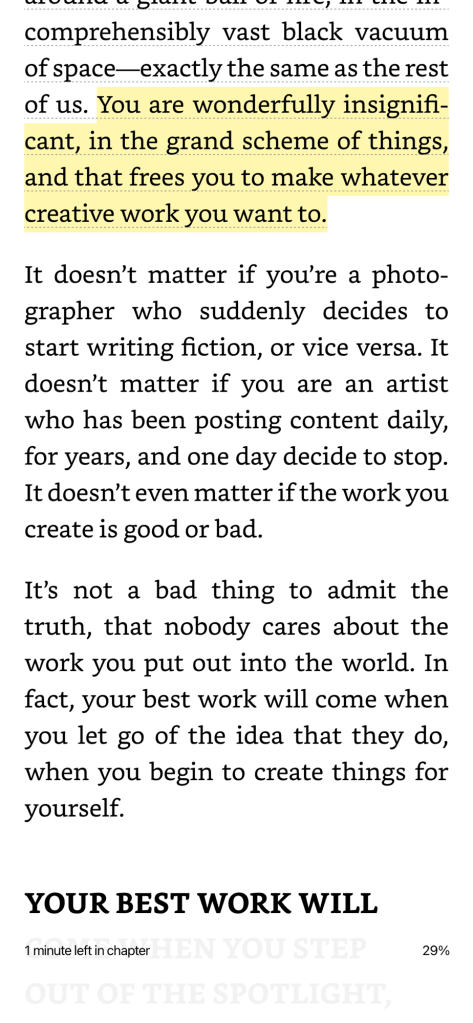
From Lee Crutchley’s book. On about the 25th re-read.
What are you going to create this year?
Whatever it is, put your heart into it.
If not, it really isn’t worth the effort.
From Lee Crutchley’s book. On about the 25th re-read.
What are you going to create this year?
Whatever it is, put your heart into it.
If not, it really isn’t worth the effort.

The tycoons at the heads of the modern and historic media empires the world over are a story in themselves. This is that story.
From William Randolph Hearst to Elon Musk, this book demonstrates the power these people wield. For those who tried to get in their way it was never, or will never be, easy.
The Murdoch family takes up a lot of the pages with good reason. The havoc they are causing the world continues as the family navigates legal battles and infighting over ownership, whilst also trying to squeeze every last drop from the press titles it still owns.
I wouldn’t normally go for a book like this but it was great. Well written and interesting from start to finish. Highly recommend.
Physical self harm, at its most graphic and shocking, involves cutting the skin. Biting fingernails and the skin on the fingers until they bleed or deliver constant pain is a lot more subtle, but it’s the same thing. I do this latter version all the time.
(I wasn’t aware that it’s also a version of self harm, and came from the same ‘family’ of bad stuff we do to ourselves, until a few years back when I talked to a therapist about it. I’ve done it for as long as I can remember, all the way back to childhood.)
Mental self harm could be the way we talk to ourselves in light of whatever choices we make. It could be based on the way we spend our time, or the judgments we make about our behaviour in any circumstances.
Both types can benefit from treatment. Maybe the mental version leads to the physical version. (Of this, I’m not certain, but I suspect there is a strong link.)
They’re definitely both worth working on to remove them from your life.
I see the link between thoughts and actions. Everything starts with our thoughts – the good and the bad. Making an effort to use what we say to ourselves, how we talk to ourselves, as a force for good can be transformational.
Some simple daily reminders of this – triggers for changing the response to something bad, for example – are something I’ve been working on. They make a huge difference.
The plasticity of our brains – neuroplasticity – means that we can change the way we think, but it goes on the ‘too hard’ pile most of the time.
I used to see my brain as a hard drive that worked one way, and was impossible to alter. But this isn’t the case.
The effort to make these changes is never wasted. The consequences of a life spent suffering from self-inflicted pain are not what I want for the rest of my life.
Go sit in a church. Not for the religion unless that’s your thing. Meditate. Enjoy the silence. Feel safe.
Listen to an album. Listen to it, stop everything else. See where it takes you. Make some notes on the feelings you feel, plus anything else that pops up in your head.
A smell in the place you work. Coffee maybe, a candle, incense sticks. It gives you a sense that you’re in your space.
Buy something for yourself. A piece of clothing you like (rather than need). A t-shirt, maybe. A pen or a notebook. Don’t go crazy on price; it’s just a small token.
Watch a favourite movie. Spend the couple of hours totally into it. No other distractions.
Exercise. Even a dozen squats while you make a coffee is something. The more you can do, the better. Do whatever you can.
Treating yourself like someone special, someone who deserves to be treated well, will make you stronger.
You have a lot to give.
You’re valuable.
You deserve it.
I started writing in early 2020 in simple lined notebooks as a way of straightening out my thinking. By June of that year I had started my fifth book.
There was a lot coming out. I was 48 years old. Life was a struggle. I couldn’t seem to make anything stick.
I had been working on my own small business for about 4 years. It was making money and a small team was supporting me but there was little satisfaction coming from the work I was putting in.
The writing stopped me in my tracks.
From my writing, I could see that things had to change. I could map out ideas for the future, make sense of the lack of fun, the lack of progress, and the breakdown in my self-belief.
It did a couple of important things that I needed at the time – it put it all there in front of me, and it set me on a new path.
One of the by-products of continually writing these notes has been the ability to revisit them. The progress I’ve made since those dark days is clear.
I took time to listen to what was going on inside myself, and being real about my attitude to life. I hadn’t done this before, and I’m glad I began to. It’s unlocked much more than I thought it would.
The words I wrote are hard to look back on but they needed to be said. I had to have this kind of talk to myself, being honest about where my life was at.
It all came out on the page once I committed to the process, the practice, of writing things out.
When I think back on how powerful a tool it has been (and still is), it’s up there with the best things that I’ve ever done for myself.

Was at a cafe this morning with my wife and the dog. A guy who works in the same industry as my wife showed up, and he began talking about their ‘shared’ challenges.
He complained of a lack of time, about having too many things to do, and that he doesn’t see an end to this in his business. He was complaining about how busy he is while also mentioning his upcoming three week vacation (how fabulous?!) that was stressing him out…
I asked if he has a target to aim for, an end point for his business, and he shrugged his shoulders to express that he doesn’t, while looking at my wife to join him in agreeing this is always the way in their world.
It was a sixty second encounter but it spoke volumes.
Unless he begins to think differently, it will never end. His first world problems were not uncommon to ‘busy professionals’, but his level of relative misery was crying out for company. I’m sure he finds it often.
Surround yourself with people who hold you to a plan. Who lift you rather than drain you. Who you aspire to learn from and spend time with. Who help you get the best out of your life each day and cheerlead for you constantly.
The rest? Move on from them. Don’t get dragged down to their level.
They’re looking for people who agree with their outlook on life. People who validate their way of operating and share the same perceived challenges as they do.
If you’re on a down day, maybe you’ll feel like agreeing with them. Assume this isn’t going to work out well for you over the long term.
You’ll be keeping misery company soon enough, like two alcoholics propping up a bar, and it’ll become harder and harder to show it the door.

Be nice to people, whoever they are and whatever they do.
Do it genuinely.
There is zero to gain from thinking, speaking, or saying bad stuff to, or about, other people.
We all have our own stuff to deal with that makes us imperfect, so until we are perfect (and we know that’s never happening) we have no right to pick holes in others.
Even if it only shows in a subtle way, or in our thoughts, cut it out.
How people react to us is up to them. They day they’ve had, or are having, is unknown to us. Don’t take any of it personally.
One day we see the world as rosy, the next it can be nothing but problems.
We can write ourselves off, with our brains giving us no chance to succeed.
It takes self belief. The ability to decide and act is all on us.
The ability to override our brains is also on us.
It’s a choice.
All we are is the product of our choices.
Heard this very special quote this morning, from one of the ancient Greek poets:
“Become such as you are, having learned what that is.” – Pindar
Until we take time to understand ourselves and our purpose, we can’t expect to find all of the answers we crave.
Understand your true nature.
Your strengths, weaknesses, and passions.
We are in such a hurry to get to the solution (especially us men). This isn’t always the ideal solution.
The answers will come when we stop and think.
Give it a try. Embark on your own voyage of self discovery.


The hard work is ahead. I’m running a final marathon this year before my knees break down.
I got through the hurdle of a half marathon last week. Training now steps up to distances much further, staying on my feet for longer.
It’s always harder in my head than it is to do the actual running.
The running is the fun part. The pain comes and I grind through it. One foot in front of the other, over and over.
Thinking about it – letting my brain get in the way – makes the task more difficult.
When we run, pushing towards our physical limits, we get a look at how we react to pain and stress. We hear our brain telling us to slow down, take shortcuts, or simply stop.
The challenge is laid down – easy or hard path? Which one do you want? Growth or stagnation? Settle for what you have, for who you are right now, or grow into someone else? Someone you don’t know yet. Someone you’ve never met.
The action gives us the answers.
The act of not doing what my brain says, and doing what my plan says – following my process – is where the growth comes from.
The act of ‘less thought, more action’ doesn’t apply universally, but the more I take action without the ‘what if…?’ thoughts that let the brain get the upper hand, the better the results.

Thinking about your influences and the things that have shaped you through your life is something that I’m a big fan of.
Where do you spend your most of your time? What kind of books or magazines do you read? What sports are you interested in and how do you keep fit and exercise? Do you enjoy cleaning and polishing your classic car at the weekend or do you always go for a long run? These few things are the tip of the iceberg and I realise that our childhood and upbringing plays a massive part in what we do as we get older but it can pay off to pay attention to this stuff.
If you have an awareness of the things that make you tick this should drive you towards spending more time doing them. They are pointing at your passions in life and this is where the best work of our lives comes from. This is the place where work doesn’t feel like work and we tend to be at our happiest when we are doing these things. Pay attention and see where it can take you.
—
Ian Mountford is a global recruitment expert and strategy coach providing motivation and guidance to entrepreneurs, wannabe or fully-fledged. He draws from his own experience of building businesses from the ground up and spending many years helping clients to consistently achieve their goals and aspirations. Ian works with clients face-to-face and internationally.
 Ian Mountford