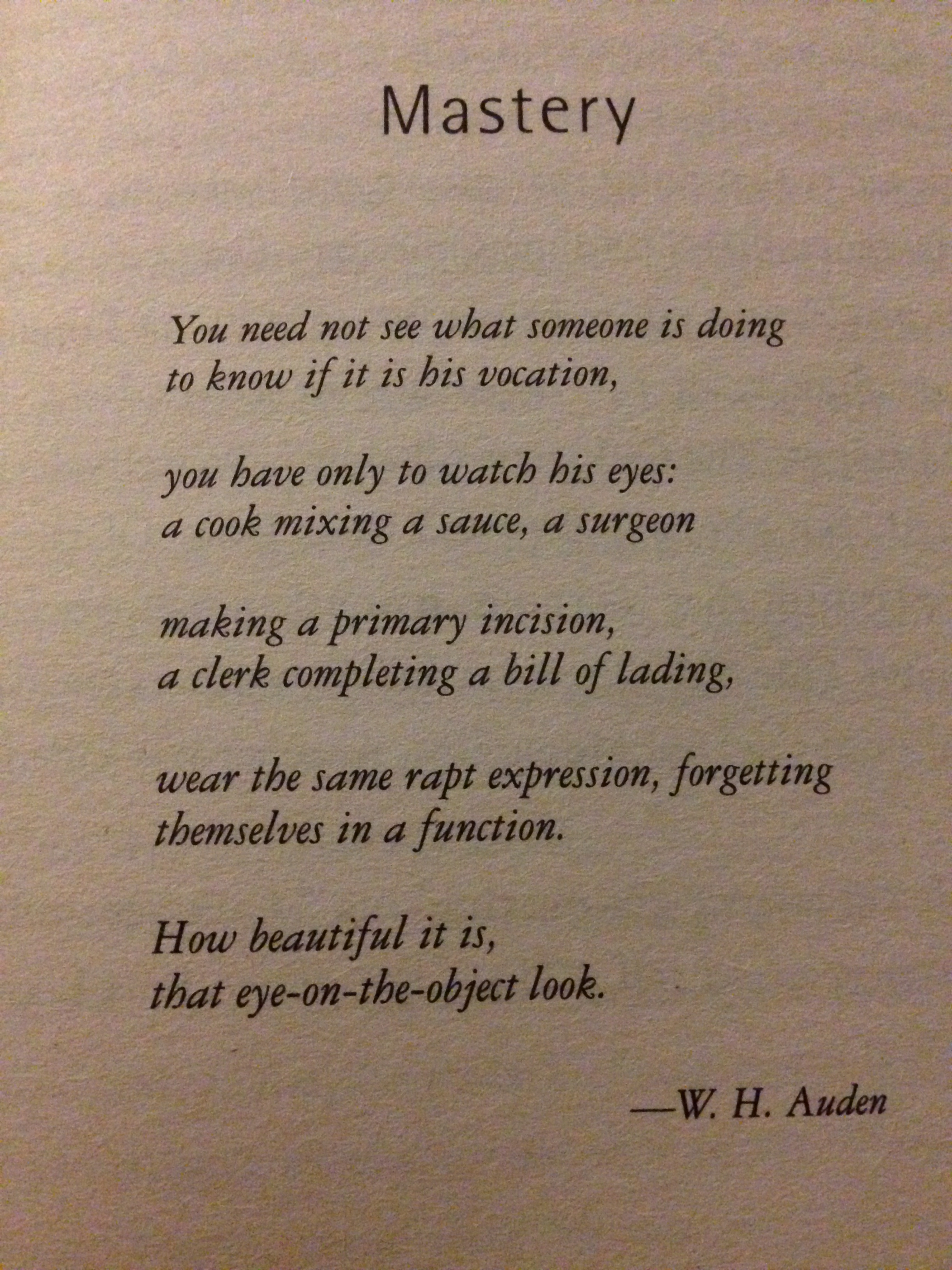
Have been reading Robert Greene’s ‘Mastery’. It’s a very interesting and insightful book. Uses a system to categorise the steps involved in becoming a master of anything.
Definitely goes onto the ‘highly recommended’ list.
Have been reading Robert Greene’s ‘Mastery’. It’s a very interesting and insightful book. Uses a system to categorise the steps involved in becoming a master of anything.
Definitely goes onto the ‘highly recommended’ list.
I’ve noticed in the last few days my brain is racing between a huge range of thoughts.
I haven’t done much differently in terms of daily routines. Not drinking more coffee than normal, and drinking less alcohol than I have in recent times.
The ability to focus on achieving one task without three others popping into my head has escaped me.
I’m taking note of the things that pop up in a notebook. It’s all mundane, normal stuff. Nothing groundbreaking.
Maybe it’s a sign that I have a lot of things to do in life in general (this is a long list), or maybe my brain has started to fire in different ways.
It could be the start of some new pathways, too. There could be a shiny thought among the mundane ones somewhere on this journey.
Keeping myself in listening mode right now is important. There will be a house move in the near future, and some travel towards the end of the year. A change in seasons is upon us as the sun comes out and the temparature rises.
Time to tune in and listen to what’s going on in my brain.
There has been a lot of upheaval in the last few weeks. This could be my brain’s way of resetting.

Choose to focus on what you can control.
This helps me to move on in life, to achieve things in spite of whatever is going on around me.
Being sucked into the drama of others does nothing to help us.
Distraction and anger. The pain of injustice. All the bad things that take us off our own path.
Put the focus on your own energy. How you spend your time. What you eat. What you do in your quiet time.
Tune out of the unnecessary stuff, tune into yourself.
This applies to many things, however, the core of this premise is its applicability to your work, no matter what it is.
Be so good that your colleagues, clients and bosses have to take notice of the work you do.
It might be the way you do it. The level of quality that you are reaching every time you send an email, for example. The style of your communications. The way you listen.
Or it could be a technical proficiency. Something you’ve honed over many years of practice and repetition.
Whatever it is, work as hard as you can on making it a little better every day.
It is not wasted time. The effort will stand up under pressure.
Sometimes this stuff is drowned out by the policiticans that inhabit every workplace. The game-players. The ones who will burn anyone to get what they feel they deserve.
In general – and I have seen this play out over time – those with the skills become dependable, reliable, and essential to leaders when they’re making their picks.
I know which camp I’d rather be in.

What do I like when I deal with other people?
How do I get this from other people? Do ALL OF THE ABOVE for them first.

It helps to know the things you’re not so good at. The things you should work on. The things you know you should deal with.
They have a tendency to get ‘lost in the fog.’ Piles of paper cover those lists of once important and urgent tasks you wanted to get done but never got around to.
It may not feel comfortable to write these things down. Seeing your weaknesses, your blind-spots, on the page can be challenging.
It’s in this type of awareness that opportunities for growth live.
They could be learning opportunities. Skills you could brush-up on, or new ways to pass the time.
But they be complete attitude shifts, or changes to ways of working. The recognition that you talk too much at certain times could, for example, open up a new line of thinking and action.
The benefits on a daily basis may not be immediately visible or measurable. Be consistent and they soon will be.

Find one thing to do today that might improve your life, and then go do it.
I’ve been mulling over a lot of stuff. The lists are overwhelming.
What one thing could I do today to make my life better? This is the question that I need to ask.
And it’s then all about the action. The motion, mentally or physically, of doing something about the answer.
Small is ok. We have to start somewhere.
Then do it everyday.
The journey to a better life starts on a road of consistent improvement.

Think of preparation as your personal success code. When you’re prepared, fear dissolves because there are no surprises. It’s like having a roadmap for a road trip. You know exactly where you’re going.
Here’s what happens. Preparation builds confidence, and confidence always beats fear. Consider a job interview. Research the company and practice your answers and walk in calm and collected. The unprepared candidate? They’re sweating bullets.
Doubt keeps us from discovering our true potential. It whispers ‘what if you fail?’ But when you’re prepared, that voice gets quieter. You’ve done the work, so you know you can handle whatever comes.
Be methodical about your process. Create checklists, run through scenarios, expect challenges. This isn’t overthinking. It’s strategic preparation that transforms anxiety into assurance.
Always be prepared. It’s your fastest path from fear to confidence.
No idea who said this but it always hits hard.
In peaceful times, we must get ready for hard times ahead.
Just like you pack an umbrella before it rains, it always pays to be prepared.
Make friends, work hard to keep them, save some money, and be a good person.
Don’t ever wait for trouble to show up. Get ready while things feel good.

A quote from Kevin Garnett, ex-Celtics basketball leader, stood out in the Netflix show ‘Starting 5’:
“Stay humble, stay confident, stay on your craft.”
The humility keeps us grounded. We always move faster with our feet on the floor.
Confidence is the fuel our ambition needs to keep pushing forwards, no matter what we face.
I think the work on your craft, whatever that craft is, with the other two sprinkled into the mix, can be the difference between average and overachievement.
Go sit in a church. Not for the religion unless that’s your thing. Meditate. Enjoy the silence. Feel safe.
Listen to an album. Listen to it, stop everything else. See where it takes you. Make some notes on the feelings you feel, plus anything else that pops up in your head.
A smell in the place you work. Coffee maybe, a candle, incense sticks. It gives you a sense that you’re in your space.
Buy something for yourself. A piece of clothing you like (rather than need). A t-shirt, maybe. A pen or a notebook. Don’t go crazy on price; it’s just a small token.
Watch a favourite movie. Spend the couple of hours totally into it. No other distractions.
Exercise. Even a dozen squats while you make a coffee is something. The more you can do, the better. Do whatever you can.
Treating yourself like someone special, someone who deserves to be treated well, will make you stronger.
You have a lot to give.
You’re valuable.
You deserve it.
If you’re not OK, you’re not going to be of use to those around you.
The temptation is there within us to jump in and fix other people who we think need fixing, but this is not required, especially if we are struggling ourselves.
On an aeroplane, we are told to put our own oxygen mask on first before helping anyone else. It’s for the same reason.
This principle is easy to read but can be difficult to put into practice.
Set your life plans up to fix the things that you find difficult, then see if you can help others through your learnings.

Was at a cafe this morning with my wife and the dog. A guy who works in the same industry as my wife showed up, and he began talking about their ‘shared’ challenges.
He complained of a lack of time, about having too many things to do, and that he doesn’t see an end to this in his business. He was complaining about how busy he is while also mentioning his upcoming three week vacation (how fabulous?!) that was stressing him out…
I asked if he has a target to aim for, an end point for his business, and he shrugged his shoulders to express that he doesn’t, while looking at my wife to join him in agreeing this is always the way in their world.
It was a sixty second encounter but it spoke volumes.
Unless he begins to think differently, it will never end. His first world problems were not uncommon to ‘busy professionals’, but his level of relative misery was crying out for company. I’m sure he finds it often.
Surround yourself with people who hold you to a plan. Who lift you rather than drain you. Who you aspire to learn from and spend time with. Who help you get the best out of your life each day and cheerlead for you constantly.
The rest? Move on from them. Don’t get dragged down to their level.
They’re looking for people who agree with their outlook on life. People who validate their way of operating and share the same perceived challenges as they do.
If you’re on a down day, maybe you’ll feel like agreeing with them. Assume this isn’t going to work out well for you over the long term.
You’ll be keeping misery company soon enough, like two alcoholics propping up a bar, and it’ll become harder and harder to show it the door.

Be nice to people, whoever they are and whatever they do.
Do it genuinely.
There is zero to gain from thinking, speaking, or saying bad stuff to, or about, other people.
We all have our own stuff to deal with that makes us imperfect, so until we are perfect (and we know that’s never happening) we have no right to pick holes in others.
Even if it only shows in a subtle way, or in our thoughts, cut it out.
How people react to us is up to them. They day they’ve had, or are having, is unknown to us. Don’t take any of it personally.
I ran 31km yesterday as training for the Sydney marathon (49 days to go). It was a miserable day; cold, wet, and windy – very un-Sydney-like.
I had three and a half hours to think about why we should all push ourselves to do difficult things.
When we take on tough tasks, we grow stronger in our minds. The muscle grows the more we challenge it.
Doing hard things also makes us feel more sure of ourselves. We prove that we can overcome obstacles, making us more confident in other areas of life.
Mental toughness increases. These long runs are small victories on the path to the big day in front of large crowds on the streets of the city. I know I can do it on the day if I’ve put the work in week to week – it all compounds.
Want to set your own challenges? Start small and work your way up. Set clear goals and keep track of your progress. Remember, the hardest things often bring the best rewards in the end.

Jurgen Klopp, Jose Mourinho, Sir Clive Woodward, Carlo Ancelotti, Sir Steve Hansen, Dave Alfred, Phil Jackson. These are the best of the best.
And the list goes on with Pep Guardiola, Xabi Alonso, Sir Alex Ferguson.
Who’s your favourite?
The examples of top coaches across the world in all sports are living, breathing textbooks.
Their life histories show similar traits. Many were ex-players. Some were winners but some didn’t get far at all.
Their former players show them respect and admiration for the things they achieved together in almost all cases.
Taking time to study their history gives us blueprints we can use for our own lives.
They always had a plan.
They had goals for their teams. They wanted the titles, trophies, domination.
They deliberated on every detail, leaving nothing to chance.
They rarely took chances, but sometimes situations in games forced their hand.
And when they did, their players responded. The players knew their job within the system they were playing in and they succeeded.
These sources of learning are invaluable.
Sports isn’t everyone’s cup of tea but the lessons are plentiful and applicable to most aspects of everyday life.
Picking up a biography of a top coach or watching interviews with them on YouTube gives huge insights we can all learn from.
Nice quote from Phil Jackson’s book, ‘Eleven Rings’ (beginning of chapter 19):
“Forget mistakes, forget failures, forget everything, except what you’re going to do now and do it.
Today is your lucky day.”
The mess our brains can make of getting through each day is real.
Competing interests, pressure from all sides, the desire to be perfect, all that nonsense.
If you can get into the ‘chop wood, carry water’ mindset, the noise in our brains quietens.
Find the focus in the next task you want to do and go do it. Then the next, over and over.
Sports books and metaphors from sport, or Buddhist philosophies for quieting a noisy mind, don’t sit well with everyone, but they can help you put the pieces together that work for you.
It’s about what you need to get through the day.
I was chatting to someone at the office the other day. We got deep quickly on the topic of a mutual coworker – someone with a few issues in their life.
They are bleeding all over the rest of us with their sighs and “it’s all too hard…” comments about the job, leading to some poor performance. The slack created has to be picked up, of course, so no-one’s happy about it.
The chat goes downhill fast. It becomes a pile-on. Within minutes, we’ve gone way beyond anything uplifting or light and down into the murky waters.
By the end of it, we’re all stirred up. Our own productivity levels drop through the floor. The blame for this is clear, too – definitely nothing to do with us… we’re perfect!
But we are to blame.
The chat is gossip that takes us downhill faster than a black run. The decision to avoid the idle banter and stay focussed on the job sets those who get stuff done apart.
Step away. Do something else. Don’t take the bait. Stay in a positive frame of mind rather than taking the easy path and teeing off on someone who could be in real trouble.
It never ends well for those who love this kind of behaviour. The gossip kings and queens are not the ones to hang out with. Build a relationship with them, as with everyone at work, but don’t join them when the sourness takes over.
Rise above it. Be the one who leads the team in the right direction.
Don’t add fuel to the fire. Let it burn out.
The list of business skills is enormous, but which one is the most valuable?
Each non-fiction business book has it’s hot favourite.
Sales is always up there, especially because you can so easily convert the value into the metric of cash.
Communication and leadership skills are also important and often lauded as ones to work on at all opportunities.
One of my favourites is negotiation. It cuts across so many other areas of our lives and has a huge effect when you understand the psychology at play.
And the list goes on…
Marketing, coaching and project management…
Networking and looking after the numbers…
Their importance can differ depending on who you follow or talk to.
What comes top of your list?
“The vitality of our network will determine our professional fate.” From The Little Big Things: 163 Ways To Pursue Excellence (2010)

The work of Tom Peters is well worth getting to know if you are interested in learning how to improve your work life and, if you are a manager, get the most from your team.
Mr Peters learned the basics in the US Navy, collecting his postgrad qualifications following active service in the Vietnam War. He also spent some time in the White House in the 70’s as a senior advisor to the Nixon administration. But the experience for which he is most renowned is his time with McKinsey & Co in the late 70’s/early 80’s – with his co-writer Bob Waterman he wrote ‘In Search of Excellence’, one of the most popular books on organisational effectiveness there has ever been.
Nowadays, Mr Peters writes and speaks extensively on getting the most out of yourself and those around you in the workplace. The quote above is taken from one of my favourite books and it’s one I highly recommend for some true pearls of wisdom on how to achieve excellence at every level and in everything you do.
It’s all about being helpful, caring about people, doing a great job no matter what and about delivering excellence in the face of whatever you are confronted by. Reading this book also makes you immediately get off your backside and take some action which is one of the main reasons I love reading his work so much.
If you’re someone that loves to learn and finds that taking action is the best way to effect some kind of change, make sure you add this one to your shopping list.
 Ian Mountford