Tag Archives: howto

Make a plan for success

It’s easy to whinge and moan about not having enough.

Money, time, friends, skills. These things don’t turn up by accident.

A plan will get you on the path to making good things happen.

They are never set in stone. They can change as life takes you in different directions. Reviewing plans is a part of the process of staying on the right track.

But you’ve gotta have one. Avoid it and the weeds will overtake the flowers in your metaphorical garden.

Your direction and purpose will be unclear.

Spend a few minutes working out what you’re going to do today and write it down. This is where it starts.

Routines for the win

You know what you should be doing. But knowing and doing are two different things. Good routines bridge that gap.

Look around. You already have tools for success.

Maybe it’s books on your shelf. A notebook in your drawer. Exercise gear in storage.

Stop waiting for perfect conditions.

Pick three things that matter most to you. Make them as automatic as brushing your teeth. No thinking required. No mood checks. Just do them.

Set up spaces that make success easy.

A reading corner. A writing desk. A workout area.

When the space is ready, you’re more likely to show up.

Make it non-negotiable. Stop negotiating with yourself every day. Decide once, then follow through.

Treat your important routines like appointments you can’t break.

Now take action – pick one routine. Set up the space. Do it tomorrow morning. No excuses.

Small steps create big changes.

Getting good at something

This applies to many things, however, the core of this premise is its applicability to your work, no matter what it is.

Be so good that your colleagues, clients and bosses have to take notice of the work you do.

It might be the way you do it. The level of quality that you are reaching every time you send an email, for example. The style of your communications. The way you listen.

Or it could be a technical proficiency. Something you’ve honed over many years of practice and repetition.

Whatever it is, work as hard as you can on making it a little better every day.

It is not wasted time. The effort will stand up under pressure.

Sometimes this stuff is drowned out by the policiticans that inhabit every workplace. The game-players. The ones who will burn anyone to get what they feel they deserve.

In general – and I have seen this play out over time – those with the skills become dependable, reliable, and essential to leaders when they’re making their picks.

I know which camp I’d rather be in.

The spin cycle

William Bridges talks about transitions. I was given his book by a mentor 25 years ago. At the time, I was fumbling my way out of university and into a career, constantly complianing at how long it was taking to pan out.

The book was ‘The Way of Transition’. I have kept it close ever since. It contains clarity at times of stress, confusion or change.

When I first read the book, I remember telling friends I felt like I was in a washing machine – soak, suds and then spin. And the spin cycle was going on for a long, long time.

Sleep wasn’t good. My head was playing tricks on me. The basics of life were out of sync.

I learned that this is the neutral zone. The ‘waste land’ Bridges talks of where there is no life, no growth. Just vast, empty space.

It’s the place we go through when life happens and change is forced upon us.

It’s a harsh landscape. There are no signposts or pathways. A bit of gravel here and there if you’re lucky.

Not much is clear in any direction, and nothing you can do will change this.

All you can do is wait. Things will eventually offer themselves up. Like Dorothy in the Wizard of Oz, you’ll find your way back to Kansas, but it’s not the same Kansas you left.

Reading and writing

I’ve had a change in my circumstances in the last couple of weeks. Reading and writing have helped me work my way through it in my mind.

They create a path to answers when you do both with a sense of purpose.

Both skills are worth the time and effort that it takes to see an improvement. They serve each other. Reading primes the writing pump.

Take a 30 to 60 minute reading block. Non-fiction works for me. Then step away for an hour. Make some food or get a workout done.

Then sit down and recall what you read and write about it. See what comes up.

It’s a handy double-act.

Adult behaviour

What do I like when I deal with other people?

  • On time.
  • Honesty.
  • No drama or histrionics.
  • Professional all the way.
  • No swearing.
  • They listen to everything I say.
  • No interruptions.
  • No talking over me when I speak.
  • Clean and presentable.
  • Positive and confident body language.

How do I get this from other people? Do ALL OF THE ABOVE for them first.

Quote from Zen and the Art of Motorcycle Maintenance

“So the thing to do when working on a motorcycle, as is in any other task, is to cultivate the peace of mind which does not separate one’s self from one’s surroundings. When that is done successfully, then everything else follows naturally. Peace of mind produces right values, right values produce right thoughts. Right thoughts produce right actions and right actions produce work which will be a material reflection for others to see of the serenity at the centre of it all.”

Robert M. Pirsig

How do you view yourself?

Self talk runs constantly in our heads. That endless internal chatter. The harsh commentary that weighs heavy on our conscience.

Understanding our values helps us feel good instead of wretched. We must own who we are and attach positive feelings to it.

This sounds simple but proves difficult in practice. Fear creeps in… Am I getting too big for my boots? Is it ok to be kind to myself?

This fear blinds us to what matters most.

Being kind to ourselves is where character development begins. It’s not optional, it’s essential.

From there, we must believe it and live it.

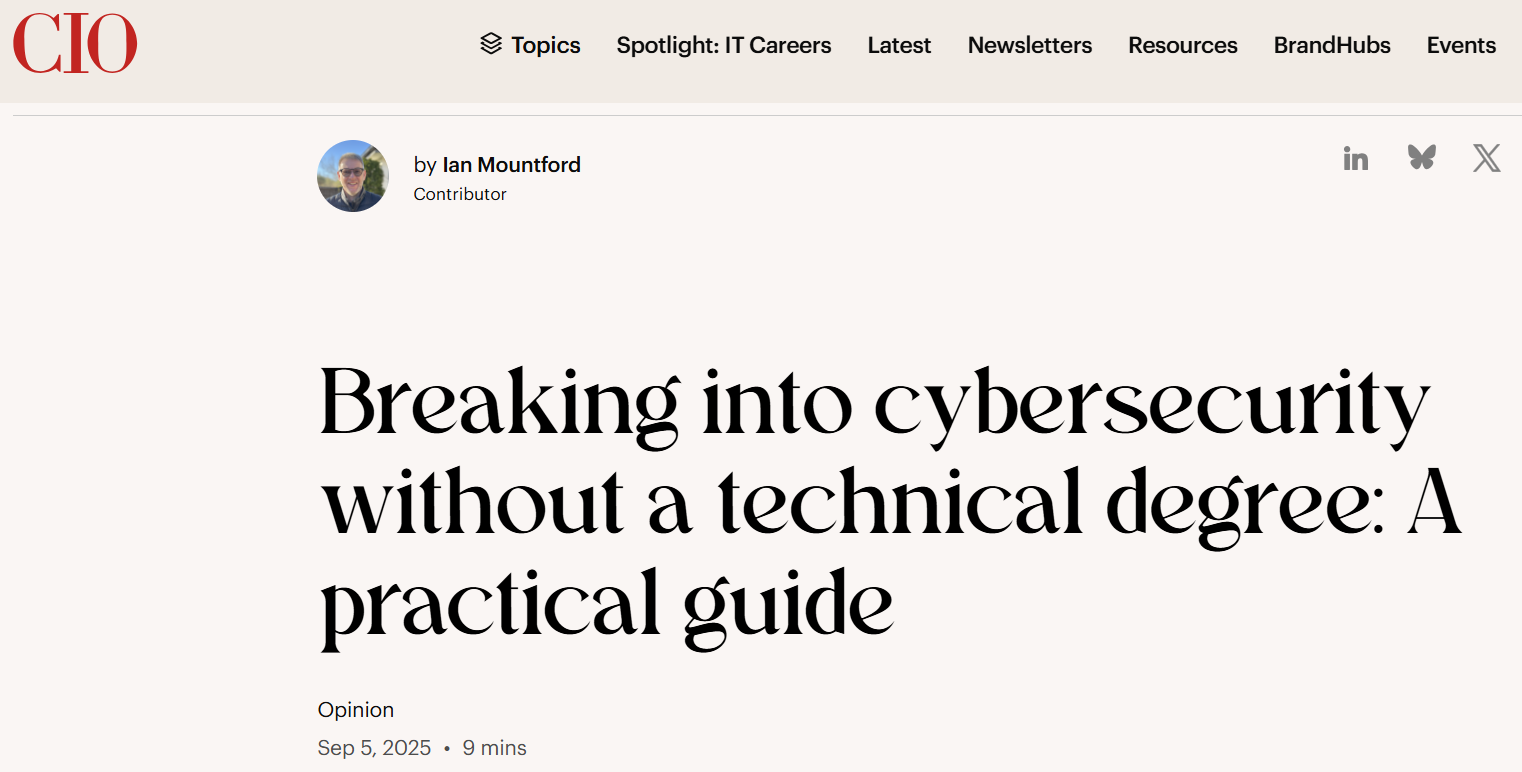
CIO.com article on cybersecurity careers for non-technical people

https://www.cio.com/article/4051515/breaking-into-cybersecurity-without-a-technical-degree-a-practical-guide.html

I was kindly offered the chance to write this article and it’s been published this week.

It gives a solid summary of my own experiences, good and bad.

If you’re in the market for a new career and cyber has caught your eye, read on.

And if you’re not a coder, even better.

Red Hot Chilli Peppers

Listened to an interview with the band and Howard Stern last night.

These guys are workers. The play their music hard, day after day. They hit the rehearsal room and work.

The things we see – the shows and the energy – are the peak of their powers. Day to day, these guys are trying new things. Making mistakes, ploughing through new stuff and finding the gold.

Flea said that when they go on stage for any show, they go at it as if there’s an axe murderer waiting for them the minute the show is over who’s going to kill them all.

They burn the boats. They crucify on stage, killing it. The crowd receives the sacrifice of their energy.

Anything you want to do well could benefit from the same approach.

Don’t complain that things aren’t working out for you unless you attack them in the same way.

Computerworld interview – my career journey

My career journey has been an interesting one.

My mate Matt has got the best out of me here and dug a bit deeper than the usual stuff these videos contain.

Lots of good stuff in here if you’re on the path to a cyber career, or really any kind of new career and find yourself in transition.

Know your shortcomings

It helps to know the things you’re not so good at. The things you should work on. The things you know you should deal with.

They have a tendency to get ‘lost in the fog.’ Piles of paper cover those lists of once important and urgent tasks you wanted to get done but never got around to.

It may not feel comfortable to write these things down. Seeing your weaknesses, your blind-spots, on the page can be challenging.

It’s in this type of awareness that opportunities for growth live.

They could be learning opportunities. Skills you could brush-up on, or new ways to pass the time.

But they be complete attitude shifts, or changes to ways of working. The recognition that you talk too much at certain times could, for example, open up a new line of thinking and action.

The benefits on a daily basis may not be immediately visible or measurable. Be consistent and they soon will be.

The power of preparation

Think of preparation as your personal success code. When you’re prepared, fear dissolves because there are no surprises. It’s like having a roadmap for a road trip. You know exactly where you’re going.

Here’s what happens. Preparation builds confidence, and confidence always beats fear. Consider a job interview. Research the company and practice your answers and walk in calm and collected. The unprepared candidate? They’re sweating bullets.

Doubt keeps us from discovering our true potential. It whispers ‘what if you fail?’ But when you’re prepared, that voice gets quieter. You’ve done the work, so you know you can handle whatever comes.

Be methodical about your process. Create checklists, run through scenarios, expect challenges. This isn’t overthinking. It’s strategic preparation that transforms anxiety into assurance.

Always be prepared. It’s your fastest path from fear to confidence.

Simplicity rules

Here’s a list I made and stuck on my wall when I was in my 20’s, a long time ago. I think it came from a book but I couldn’t tell you which one:

  • Buy what you want, instead of what others say you want.
  • Think for yourself, instead of being told what to think.
  • Recognise that there are many things more important than money.
  • Fulfil the demands of work without being controlled by it.
  • Live in a way that is self-determined and original.
  • Talk less, think more.
  • Know what you want.
  • Not cost, but value.
  • Buy one, chuck one.
  • Organise your environment.

They still stand the test of time.

Some of these statements wash over us easily as hogwash when we’re in the eye of the storm, fighting daily fires, and getting mad at social media posts.

When we sit back, take a few deep breaths, and see the wood for the trees, the sense in these words hits hard.

The difference between average and overachievement

Garnett at the peak of his powers, around 2008.

A quote from Kevin Garnett, ex-Celtics basketball leader, stood out in the Netflix show ‘Starting 5’:

“Stay humble, stay confident, stay on your craft.”

The humility keeps us grounded. We always move faster with our feet on the floor.

Confidence is the fuel our ambition needs to keep pushing forwards, no matter what we face.

I think the work on your craft, whatever that craft is, with the other two sprinkled into the mix, can be the difference between average and overachievement.

Changing the way we talk to ourselves

Physical self harm, at its most graphic and shocking, involves cutting the skin. Biting fingernails and the skin on the fingers until they bleed or deliver constant pain is a lot more subtle, but it’s the same thing. I do this latter version all the time.

(I wasn’t aware that it’s also a version of self harm, and came from the same ‘family’ of bad stuff we do to ourselves, until a few years back when I talked to a therapist about it. I’ve done it for as long as I can remember, all the way back to childhood.)

Mental self harm could be the way we talk to ourselves in light of whatever choices we make. It could be based on the way we spend our time, or the judgments we make about our behaviour in any circumstances.

Both types can benefit from treatment. Maybe the mental version leads to the physical version. (Of this, I’m not certain, but I suspect there is a strong link.)

They’re definitely both worth working on to remove them from your life.

I see the link between thoughts and actions. Everything starts with our thoughts – the good and the bad. Making an effort to use what we say to ourselves, how we talk to ourselves, as a force for good can be transformational.

Some simple daily reminders of this – triggers for changing the response to something bad, for example – are something I’ve been working on. They make a huge difference.

The plasticity of our brains – neuroplasticity – means that we can change the way we think, but it goes on the ‘too hard’ pile most of the time.

I used to see my brain as a hard drive that worked one way, and was impossible to alter. But this isn’t the case.

The effort to make these changes is never wasted. The consequences of a life spent suffering from self-inflicted pain are not what I want for the rest of my life.


Tackle the hard stuff

The hard stuff you don’t want to do is the stuff you have to do.

I don’t know if there’s science to back this up. It tends to always be the case that when you break the back of the hard thing, other things topple over like dominos.

The comfort zone lures us in. The fear of failing that hard thing, being shown up for not achieving, leads to avoidance.

Or we just get lazy.

The benefits come when you take the task on.

You’ll grow. You’ll surprise yourself. Inner strength you didn’t know you have will turn up and say ‘Hi!’.

It can be simple stuff like starting conversations with strangers or hitting the gym.

Signing up for a college course can freak us out, and they are hard to fit into a busy life, but why not give yourself a chance to find some of that growth you’ve heard about?

Break the big task down, set some milestones, and put a red circle on your calendar on the end date – party time!

Get your squad together

Friends are important.

Alone, broke, no prospects, and the world will swallow you up faster than you can call for another pizza.

The size of your brain is not equal to the way your life goes.

It’s how you use that brain. It’s about who you hang around. What plans you make. The actions you take.

The people you lift up along the way are a sizeable part of it, too. It ALL matters.

A couple of bad steps can bring this lonely place closer than we would like.

Don’t be this person. Take the skills you have and develop them.

Use your brain, put a plan together, focus on making it work.

Stick to the course. Watch out for the luck we all need (that seems to pop up when you least expect it), get your squad around you, take the chances you get, put the pieces together, and deliver on the plan.

Get help if you need it, but most importantly, do the work. There’s no replacement for that.

On expertise

Pick your one thing as early as you can and become an expert at it.

There’s an example I heard of a top tax lawyer being very happy with the way their life has worked out after a couple of decades or more working in a narrow, perceivably dull, area.

Go deep and narrow. There will always be good things going on there the longer you stay in the space, learning and evolving.

The tax lawyer will be satisfied at the end of their working days once they retire, financially secure, with a legacy earned from a raft of loyal clients.

They may have built their own practice or just be a well-known expert in the space in high demand.

Assume you can do this for yourself and work hard to achieve it in your space.