Category Archives: Work

21st century capitalism producing 19th century working conditions?

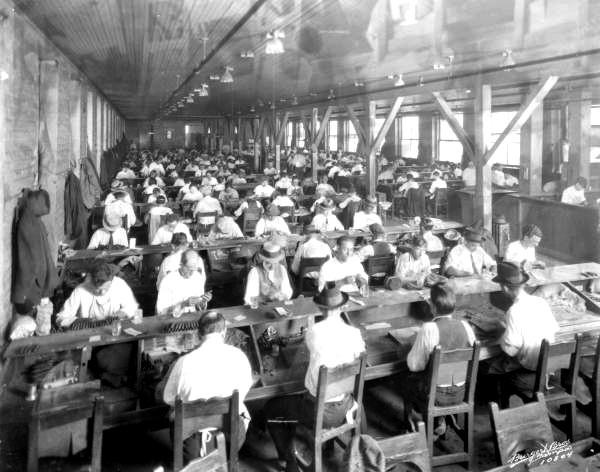
factory floor 19c Read an article in the last couple of days by Stanley Bing (Fortune Magazine, US edition – December 2014) where the topic above is discussed. The comparison between the centuries is made to suggest that working conditions we are now being sold as new, cool developments – open plan offices, no job security, super rich bosses, etc – are really a reincarnation of the way things were back in the days of Dickens. It’s quite a topic and one that is hard to argue against. There is a big income disparity in the workforce and it’s growing all the time. Freelancing as a way of life is one thing, but zero hours contracts and the like are quite another. And open plan offices really are a modern day version of the factory floor – gossip flowing free and fast, constant visibility and the daily exodus as the clock strikes 530pm. One definitely to ponder, and one I’m going to be discussing as I talk to the Digital Leaders North West Salon in Manchester in the middle of this month. Looking forward to hearing their thoughts.

Ian Mountford is a Strategy Coach providing motivation and guidance to entrepreneurs, wannabe or fully-fledged. He draws from his own experience of building businesses from the ground up and spending many years helping clients to consistently achieve their goals and aspirations. Ian works with clients face-to-face and internationally.

Everyday negotiation basics anyone can master

Negotiation – it’s an art, not a science

cash-reserves1

We are all negotiators. Some of us are more adept at it than others and some of us have a lot more practice and experience of it than others. Some of us are classified as professional negotiators based on the fact that we get paid for doing it and some of us will never be paid to negotiate but do it all the time. It’s a critical skill and one where a little bit of practical knowledge and preparation can go a long way to helping you get better results, whether it’s in a salary negotiation with your boss or in a purchase of something as valuable as a house or a car, but how often do we take the time to prepare for a negotiation or put a strategy together in advance? No matter how big or small the scenario, it can make a huge difference if you know what is going on within the overall negotiation.

I bought a used car from a dealership a few years ago and got some advice in advance from friends who are professional negotiators on how to get the best deal possible. The salespeople at car dealerships are spending their whole lives doing deals so I knew I was going to need some guidance in order to come away with the car I wanted at the right price (and definitely not have that horrible experience of shaking hands on a deal and feeling that I’d been fleeced). The results were simply brilliant and the understanding I had of what was going on as the negotiation was taking place was invaluable. It was as if I was in the head of the salesman as he was bashing away on his calculator and running off to speak to his manager!

Here are the three most important things I have learned:

Prepare to win – don’t prepare and you will be relying on luck

Go into a negotiation with a positive mindset having prepared as thoroughly as you can and make sure you have all the information you need to get the deal you want. Find out as much as you can about the person you are negotiating with and their position in this deal. Are they the person who can say yes or no, or do they have to ask for permission from someone else to make a decision? On a salary negotiation, this can sometimes be an important factor – the person you are talking to may have to make a case to someone else for your raise to be agreed, so you may have to change your approach if they are not the boss holding the purse strings.

Lose the emotion – most negotiations are not life or death deals.

You must be prepared to walk away if you don’t get the deal you want. This can be really hard if you’ve made an emotional bond with whatever it is you are negotiating over, such as a new house or a piece of jewellery, so do your level best to avoid it. Walking away is a strategic move and can be the best thing you ever do in a negotiation as it can force the other party into action, but if you then have a change of heart and go back to the table, don’t expect the same deal to be available! There will always be another deal to be done and another (enter purchase here) to buy when the time, or, more crucially, the deal, is right.

Body language and voice tone – it’s a critical thing and can make or break a deal without a word being said.

There is a ton of information out there on using body language and in my job as a recruiter I have to be aware of what different signals mean. If your emotions are under control, this will also help you to control your body language and avoid giving off signals that you don’t want the other side in a negotiation to see and act upon. You can also use body language and shock tactics, such as acting really unusually or out-of-character, to mislead people and this can be very powerful in negotiation. Showing huge amounts of anger and frustration in order to force a weaker party to give way on a price when the numbers in play are not that far apart is quite common, and the opposite can also apply. Hand movements, eye twitches and all types of ‘tells’ as used in poker are also worth paying attention to. If it gives you an edge, it will be worth using.

Ian Mountford is a Strategy Coach providing motivation and guidance to entrepreneurs, wannabe or fully-fledged. He draws from his own experience of building businesses from the ground up and spending many years helping clients to consistently achieve their goals and aspirations. Ian works with clients face-to-face and internationally.
Follow the numbers

It’s very easy to just go for it when posting, blogging, tweeting, etc for business, but it does pay to follow the numbers and become less random. Timing of posts, quality of content, selection of the right message on the right platform – I want to get a better handle on this and hit it much harder from here on. 

Where/who are the best sources of information to help with strategising this stuff? If you are able to help me out with some suggestions this would be much appreciated.

Do you plan, create or do?

Very interesting article from Metro (20 Jan) passed to me about a project that attracts school-leavers to the digital creative and marketing industries with an interesting methodology. You don’t see job details and salaries when you first land on the job board – you are instead asked to identify what type of brain you have, i.e. do you plan, create or do? The choices you make are then matched to job roles that fit and jobs are listed under the same categories to make it easy to find a good fit for you.

Full details can be found here: www.creativepioneers.co.uk 

Using a consultancy to provide talent is about so much more than just paying fees

New post by me over at the 6Talent blog:
“Many organisations are doing their own hiring today because they don’t want to pay fees to agents. Many brands and businesses big and small have had bad experiences with, or feel they haven’t got value for money from, an agency and I can understand that – sadly there are many bad eggs out there and that will always be the case. Very few arguments any better than the fees one have really found their way to me and it is often the only factor against them wanting to do business. My question is, why use your own time to search for and hire people when you can partner up with a consultancy and let them help you to grow? Hiring is a skill that everyone thinks they are great at but the facts simply don’t bear this out. And getting it wrong is a huge expense, whether you have found staff yourself or not. The true cost of recruitment can be £000’s and if you make poor hiring decisions as you’re learning how to do it on your own these costs just get larger and larger.
If you have staff within your team who are key administrators or are in HR and have a bucketload of everyday work to do, is it really a cost-effective use of their time to also try to do your hiring? And if you’re a small business owner with a to-do list as long as your arm, is it really the best use of your time to be trawling LinkedIn when you could be doing chargeable work and driving new business into your firm? If you need a website, you go and get one built for your business by an agency that knows how it’s done, rather than asking your team to have a go. If you need a new car, you don’t buy it from Ford directly, you go via a dealer, and so on, BUT in each case you are paying a price and the same applies to searching for and delivering talent.
A good consultancy providing talent is a partner to your operation and is putting a great message about your business out there for all to see, promoting you at every opportunity. A good consultancy gives you market knowledge and keeps you up to speed on your industry and knows as much about it as you do. And – the big one – a great consultancy helps you make the right decision on a candidate. They help you to find the right talent for your team and assist on the process of recruitment as well as simply handing over CVs – they have this at the heart of their operating model as it’s the only thing that works. It builds a stronger relationship, strengthens the partnership and makes the process of growth so much easier for your business. You can then stick to the things that make you money and keep doing what you do best.
Is this something that’s been on your mind? Are you and your team spending huge amounts of time in trying to source candidates without hitting the mark? 6Talent are at the forefront of this service-based approach and we deliver the highest quality service to our clients and get results. If you want to put us to the test and make big long term savings, please get in touch.”

Interview no-shows

Over the years I have heard the full range of reasons for people not arriving on time or turning up late for interviews. Issues with pets, leaking washing machines, keys locked in cars and accidents and emergencies of all kinds. Many are, of course, entirely genuine and many are not, but I’ve noticed another thing on the increase and it’s not a very good sign at all – interview no-shows.
At 6Talent we take a lot of time to contact candidates and make sure they are still fully committed to the role they have applied for and ready for their interview. We have some fabulous roles that we are hiring for and we make this very clear to candidates. We call them the day before the interview in many cases, too, just to be on the safe side. But then they don’t turn up and, in many cases, don’t even have the decency to let us know.
Do these people actually want jobs or are they playing the system? Is it too easy for them to stay in bed rather than work? Why does this happen so much? Is my telephone technique losing its touch? Who knows. But what I do know is that this is a very sad and disappointing trend. Life for candidates is not going to get any easier as we see growth in many markets and competition for roles gets tougher. 
What can be done to reverse this trend? One idea mentioned was to take deposits for interview slots that are refunded when you show up. I just might have to start doing this and use the (sadly inevitable) profits for the Christmas party.

thewallstreetexecutive:

Wall Street Is About To Start Bleeding

The Wall Street jobs story everyone’s talking about today is in The Wall Street Journal, and it’s ugly.

The gist is this: Get ready for a mass exodus of traders from top Wall Street banks.

It’s not hard to understand why. The market is quiet. As a result, trading — in bonds, credit, currencies, what have you — just isn’t the moneymaker it used to be. People have been warning of this hole in bank balance sheets for months.

Especially in the second quarter, analysts expect trading revenue to nosedive, and it’s key revenue — at Goldman it makes up 30% of their quarterly haul. This deficiency means banks must find a way to cut down unnecessary costs.

Headhunters such as Richard Stein, senior partner at executive-search firm Caldwell Partners, told The Journal that there are “too many people on these trading floors” and that he’s starting to get calls from people who want to jump ship before they’re pushed out.


From The Wall Street Journal:

Mr. Stein of Caldwell Partners says he has received between 17% and 19% more calls in the past month than in the same month a year earlier from managing directors inquiring about job opportunities. Managing directors inhabit the top rung of the Wall Street career ladder.

“It’s very clear to most people that making money and profits is harder,” said a credit trader who left a large U.S. bank earlier this year. “There’s a high probability you’re going to be pushed out. Most people don’t come into a bank thinking they’re going to be there 15 or 20 years, even if they do well.”

Until the market changes — interest rates rise or things become more volatile — traders will be twiddling their thumbs. And Wall Street can’t afford that.

The opportunity in getting a better understanding of why people do what they do

I attended an event this week on conversion/optimisation that really got me thinking about this topic. The talk gave examples of subtle changes applied to web pages that seriously affected engagement, click-through rates and, very importantly in many cases, sales. My thoughts have extrapolated this out into the wider world, not just the one on the screen in front of us or in our hands. The power in getting better information on the decision making of others and understanding the behaviour of people – users, clients, customers, whoever – should never be underestimated.

It doesn’t matter what you do for a living or what market you are in. You might also be in no market at all and just want to find ways to improve your everyday existence. To me, the key here is to listen, learn and collect data, then use it to make better decisions. Way back when social media began the focus was very much on listening to what was going on – who’s saying what on the subjects you care about, who needs help, who are the key thinkers and influencers, etc. The biggest players are now spending mountains of money on this and reaping the rewards by jumping into conversations and unleashing their brand power all over the place, but we can all get better at this and use the results to be better at everything we do. Have better conversations, help people out, show we care, we understand and we give a shit. If it only has a little bit of a positive effect on the life you lead, it’s worth it.

Loggerhead Country Park, near Mold.

thewallstreetexecutive:

Working on Wall Street is ‘a dystopian nightmare’

Characters like Jordan Belfort (the DiCaprio-depiction) and Gordon Gekko fill the big screen and young minds with dreams of Wall Street grandeur and luxury. And maybe once-upon-a-time working for a big bank was full of such excess, but today, says Kevin Roose, it’s less about a spoil of riches and more about thankless work.

thewallstreetexecutive:

Administrators on the main campus of Rutgers University in New Brunswick, N.J. have suspended a renowned anthropology professor because he told students that he knows nothing about the subject matter in a course school officials assigned him to teach. The professor, Robert Trivers, had objected to teaching a course called “Human Aggression” this fall, reports The Star-Ledger. In the first lecture, Trivers informed the 30 or so Rutgers undergrads who had signed up for the class that his plan was to learn the course materials gamely along with them. Administrators at the taxpayer-funded university then suspended Trivers for the crime of imparting this information to students.

???

We are watching the development of a lost generation

Unemployment in any age group is tough enough, but when the largest growth in unemployment is in the under 25’s across the EU it highlights a really dark period ahead of us. The high cost of higher education and general scarcity of both jobs and publicly-funded training options for those leaving school at 16 are proving to be a dangerous combination.

So what are these young people going to do? If nation-states are unable or unwilling to help and employers cannot give any real opportunities, where are the answers coming from? I find this question very tough to answer and think that we should all focus a bit more on this as an issue that will get bigger and bigger as the years go by.

There are organisations out there who are willing to help but their own funding lifelines have also been cut in this economy. I did some voluntary work with a project helping the homeless in London years ago but they are long gone now and ended when the money ran out. Even in the third sector it seems that there are the have’s – big cancer charities, Oxfam, etc – and the have-not’s – smaller local supporters of the underprivileged in their own communities. The big get bigger and the smaller fade into the background, fighting for survival.

Everything tends to work in cycles and the things I mention here are part of a very obvious, yet negative, one. Being aware of it is one thing, but I’d also like to know the plan for change and action of a positive nature. A generation with poor levels of education and little work experience of any value is of no use to anyone.

Getting back to the old ways

I’ve seen some really bad examples of service and communication this year, in many areas from day-to-day retail banking (an area I have worked in) through car dealerships and restaurants and many more. It has moved me to write a few notes on this and I feel it’s an area that needs some attention. My own area of focus is HR and recruitment and I feel that this is also a sector that needs to stop and take stock of how it does in this area.

The basic statement I am making is that we need to ‘get back to the old ways’ and I’m going to try and sum it all up below and add a few things to think about:

Quality
It’s a highly used word but does it really mean anything any more? What does it stand for now? Who’s accountable? It starts with us all. Get some standards. Define it for yourself, seek it out, cherish it, support it.
Meaning
Bigger, faster, stronger, more expensive, wilder, more extravagant, more… Give your life some meaning and purpose – does it have any now? Relationships, work, experiences, evidence. Originality – thoughts, plans, new friendships… Define it for you.
Relationships
Very easy to make, very easy to break. Longevity is key. Sharing is good. Embrace the differences. Show you care. Give and receive.
Service/services
The basics are the only things that matter. Simplicity over ‘empty’ promises. Be thankful for the opportunity. Build relationships and give value. Treat those who serve you like gold. MASSIVE opportunity in getting it right.
Say what you mean
No bullshit, ever.
Be a communications ‘pro’ – listening and speaking.
The time before email and phones
People spoke face to face a LOT more. Communication was formed upon civility. Messages were written and a lot of time taken in making sure they were right. Reading and writing mattered. The world still moved forwards and the pace was acceptable to us all.