Who you see, the tools you use, where you work, the position of your desk in your home, the stuff you experience every day – it all has to support you in the daily journey towards achievement of your goals.
How can you improve your environment along these lines?
Think in terms of people, process, and technology.
Do you need to be around a more supportive crew on a daily basis?
Is your bedtime routine making it hard for you to get up on time, and therefore start the day on time, and in a good frame of mind?
Do you use software tools that help you day-to-day, or are you the kind of person who signs up for everything but uses very little functionality of each app after the initial flurry of activity once the novelty has worn off?
It could be time to move your desk towards the window for more light, or even move to somewhere new.
Are you warm in the winter, and cool in the summer, or do you need to get warmer in the winter months, for example?
Could a new picture in a frame on your desk of someone you care about make a difference to how long you spend sat there, and the quality of work you produce?
Ponder on this topic for a while.
Understanding the impact of this overarching statement can have a big impact over time. That’s our shared goal, right?
Ever used the ‘Screen Time’ app on the iPhone (see above)? (Sure there’s gotta be one on Android phones, too). It’s scary to come face to face with the real number, knowing how much content you’ve watched.
Add on the odd video on other devices. The videos in your lunch hour on the work laptop, or something your friend shows you on their phone. This stuff adds up to some massive numbers.
The time taken to produce something is far, far less than the time we spend consuming.
Why not start your own blog, or write something in your journal, or start a journal or blog if you don’t have one right now?
It has to be better for you than watching more of other people’s stuff for hours on end.
Here’s a list to start you off with what to write about:
Day to day happenings
A quote from a book you’ve read
Three things you need to get done
Things you’re thankful for
A progress review on a project of some kind
New project plans
An idea
Something funny you heard
What you’re reading, watching, listening to right now
Obviously this is only the tip of the iceberg. Use it to get started and see what your own brain can come up with.
The hard work is ahead. I’m running a final marathon this year before my knees break down.
I got through the hurdle of a half marathon last week. Training now steps up to distances much further, staying on my feet for longer.
It’s always harder in my head than it is to do the actual running.
The running is the fun part. The pain comes and I grind through it. One foot in front of the other, over and over.
Thinking about it – letting my brain get in the way – makes the task more difficult.
When we run, pushing towards our physical limits, we get a look at how we react to pain and stress. We hear our brain telling us to slow down, take shortcuts, or simply stop.
The challenge is laid down – easy or hard path? Which one do you want? Growth or stagnation? Settle for what you have, for who you are right now, or grow into someone else? Someone you don’t know yet. Someone you’ve never met.
The action gives us the answers.
The act of not doing what my brain says, and doing what my plan says – following my process – is where the growth comes from.
The act of ‘less thought, more action’ doesn’t apply universally, but the more I take action without the ‘what if…?’ thoughts that let the brain get the upper hand, the better the results.
Came across this excellent learning resource for all things AI, focussed on busy professionals looking to get ahead of the crowd quickly and efficiently.
Section – the business behind the training – is backed by best-selling author, NYU Professor of Marketing and podcaster Scott Galloway.
His work stands out in the world we live in today as forward thinking, a challenge to the status quo, and a call to action for people glued to their screens looking forward to little more than minimum wage work (and lots of it) for years to come.
Upskilling and lifelong learning are more than just buzzwords. They’re the way to stand out, get better opportunities and earn more over time.
Fighting. Throwing hands, not the mouthing off at people version. There’s a lot to be said for knowing some basic skills.
Last week, a 78 year old guy stopped me and Scott as we were training for a knife attack in the basement of our apartment block. He told us he knew his onions, and within a couple of minutes he was demonstrating his favourite side kick.
He knew what he was doing. He had an aura, some kind of inner confidence that made it clear he was ok defending himself. He was ready.
He’s got a blank stare, the kind guys in jail have, and that was all I had ever noticed before. But now I can see what’s happening behind those dead eyes. He’s staying calm, assessing the situation. He’s looking out for what’s coming next – maybe a fist, maybe not.
These skills are things you carry with you in the hope that you’ll never have to use them. I hope I never have to front up to someone, ready to go, in defence of myself, my wife, or anyone else under attack.
Things happen fast when tempers flare. Words are said. Things can escalate quickly. People right now are under a lot of stress, even here in a chilled out place like Sydney.
If someone attacked you, what would you do? How would you get away from an attacker, for example? If all hell breaks loose around you, what’s your first move?
A basic plan, even something as simple as a rapid knee to the groin and run away as fast as you can, can go a long way.
Take that up a notch and think about classes in all forms of self defence. Krav Maga, Jiu Jitsu, whatever. When that moment happens, you’ll be glad you made the choice to start learning. It’s never wasted effort.
Stuff that’s scary, like hitting ‘publish’ on a deep, dark post that comes from the very depths of our souls, fills us with fear. The imposter jumps out on us, screaming that we’ll be ‘found out’, that our stuff is ‘nonsense’, and that nobody’s going to read it no matter how cool we think it is.
We moan about having no time. “If only I had the discipline…” must be said by so many wannabe writers and creatives. Our handheld procrastination device, full of the stuff we don’t need, pinging at us when it needs attention, is always by our side.
It’s no wonder we rarely act on that desire to do that ‘thing’.
I used to read Julien Smith’s blog in the early 00’s when I lived in the US. This particular post caught my attention as I sat at a big desk in a bigger office, bored out of my tiny mind. I printed it out. (The image of the horse jumping from the balcony has always stayed with me.)
I’ve referred back to it, and a few of his other ‘slaps to the face’, when I’ve caught myself navel gazing, feeling stuck. At the core of it is the fact that we all worry too much what other people think, and that the sooner we act on what we believe is right through telling the truth, OUR truth, a new chapter begins.
And this is the point here – whatever your ‘thing’ is, get into action by getting past your fear and start delivering.
What’s the worst thing that could happen? You could actually be good at it, people could like it and it could work out brilliantly.
This isn’t likely to be the case – let’s get real here – but the best had to start somewhere. And you do, too.
My time is tight. A full-on job plus part time study. I run or work out daily and fit golf in whenever the study slows down. I have a stack of unread books that grows weekly.
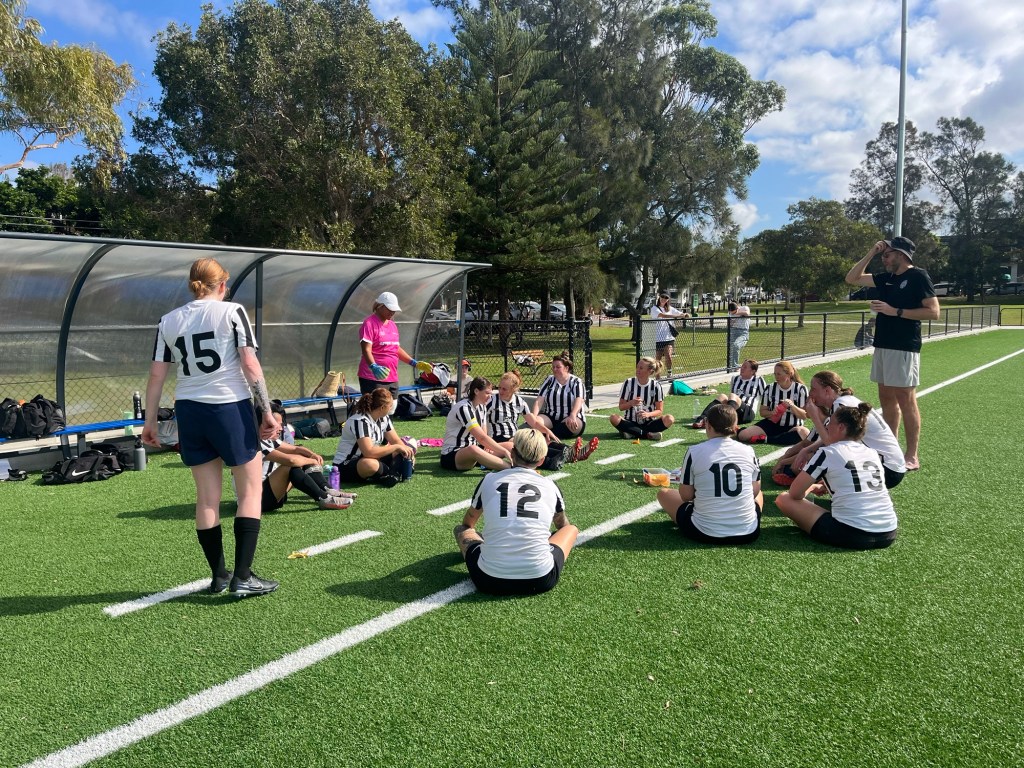
I wanted to take things out rather than add anything new, but the opportunity to coach a women’s soccer team came up, so I took the plunge and it’s a lot of fun.
I’m also inspired to write again (thanks Dr Taylor!) and deliver with consistency – the piece of the puzzle that, for me, remains elusive. But it’s far from impossible.
They ask good questions, listen to your answers carefully, and you build a great conversation together.
You find that you’ve got some shared interests. You get a good feeling while talking to them.
Has this ever happened to you?
They’re interested in other people. They allow them to talk, rather than feeling the need to share their own life story at the earliest opportunity.
They make you feel heard, understood.
When it’s their turn to speak, they’re open about their own experiences. They have stories to tell and they’re happy to tell them but they don’t drone on and on.
They keep the ball moving. The balance between listening and speaking is just right.
They’re the interesting ones.
It takes patience and practice to develop this skill, but it’s a valuable one.
Make an effort to be interesting and the investment will pay off over time.
Here are six ways you can increase your personal impact, no matter what you do.
They’re taken from a 2014 Tom Peters slide deck I printed and bound because it was so useful. I pick it up and walk through it periodically. Even time I open the pages, the words pop off the page. They never get old.
Outwork ’em
Outread ’em
Outlast ’em
Show up
Listen
Keep an open mind
I’ll also add another one – master politics. If you can understand how politics works and the role it plays in all aspects of our lives, you’ll have an advantage over the majority of people you work and play with.
Which one are you going to start working on first?
It takes guts to stand up to bad people. The same applies to problems of any kind.
The insecurity we feel when we realise what’s going on, the nerves about what will happen, begin to build. We go through every “what if…?” scenario at 100 mph.
Some people in this spot decide to hide away, playing in the shadows. It gives them a chance to cover their tracks, hoping this is enough to kill the scent.
But it never is.
You’ve gotta own up and face the problem head on. Your weaknesses are obvious to all at this point. Vulnerability here is the path to strength.
Be humble. Admit you’ve made a mistake if that’s the case. Admit you don’t know what to do. Ask for help and listen when the feedback arrives, no matter how tough that might be under the circumstances.
Get the job done. Then go find another one. Use the improvements from this episode to reach new levels.
Onwards, always to better things, with a chunk of learning about yourself in your pocket.
I just checked out the caffeine in a pack of Berocca Boost. Wow, it’s wild. That 75mg shot will jack you up for a few hours, no doubt. But how can you imporve your energy levels and not have to resort to the artificial approach?
Sleep
Making sure you get enough is massive. Your body can go for days on end with no food and little water but take away sleep and you’ll stop functioning.
Get to bed at a smart hour, say 10pm, for a week. Keep your devices out of the bedroom so there’s no temptation to check them. Set a challenge to wake up at the same time every day for a week, aiming to make it stick. That’s a great start to forming good sleep habits.
Diet
Caffeine stays in your system for as much as eight hours. That cappuccino after dinner, or the piccolo to get you through the afternoon, makes it impossible for your sleep schedule to work.
Processed foods are a big negative factor, too. The hidden fats and sugars they contain make it harder for your body to digest them, using up additional energy. Hit the fruit and veg hard for a week. Maybe start the day with a smoothie. Your brain and body will feel the benefits instantly.
Screen time
Staring at screens increases stress levels and stops you from interacting with the world. It kills your efficiency stone dead. Can you cut it down?
Less focus on screens improves your sleep for starters, giving your better quality rest. If you can shut screens down for an hour before you get into bed, you’ll also decrease stimulation sources and naturally relax before you hit the sack.
I’m no doctor and this is generic advice. Please consult the pros if this is something you have big problems with. Your energy supplies are limited so do what you can to support yourself each day. A small change or two can go a long way.
Scrolling is a death spiral. Anything you’re working on disappears from your mind. The plot gets lost.
All that replaces the work is someone else’s life or a product you don’t need. Those best bits of the lives of others, served up in that never-ending fire hose of content.
We all get blasted by it. Anyone who says they haven’t – they can deal with it, it’s under control – is not being truthful. It’s like being on a water slide. All that can stop you once you take off is the smash into the pool at the bottom.
The remorse after any amount of time spent scrolling is hard to take. I put Instagram back on my phone about one month ago. Already I can feel its hooks are firmly embedded. I’m in, posting a little and consuming a lot, just they way they like it.
And, boy, do those five minute blocks add up. Between YouTube and Instagram I’m averaging nine hours a week. The waste of that amount of time is tangible. It’s painful to see the facts, whatever level of control I imagine I have.
The challenge is to now do something about it.
Take your own audit of how the scroll affects you. The results might spur you on to some positive changes. If you can go from consuming to producing content, for example, putting those scrolling hours to good use, things could be different.






 Ian Mountford